

ESP8266 WIFI Development Board with Arduino IDE Compatibility and OTA Wireless Upload Support, Featuring 11 I/O Pins, 1 ADC Pin, and Onboard 5V 1A Switching Power Supply for IoT Projects in Black


ESP8266 WIFI Development Board with Arduino IDE Compatibility and OTA Wireless Upload Support, Featuring 11 I/O Pins, 1 ADC Pin, and Onboard 5V 1A Switching Power Supply for IoT Projects in Black
ESP8266 WIFI Development Board: Arduino-Compatible IoT Platform with OTA Updates and 5V Power Supply
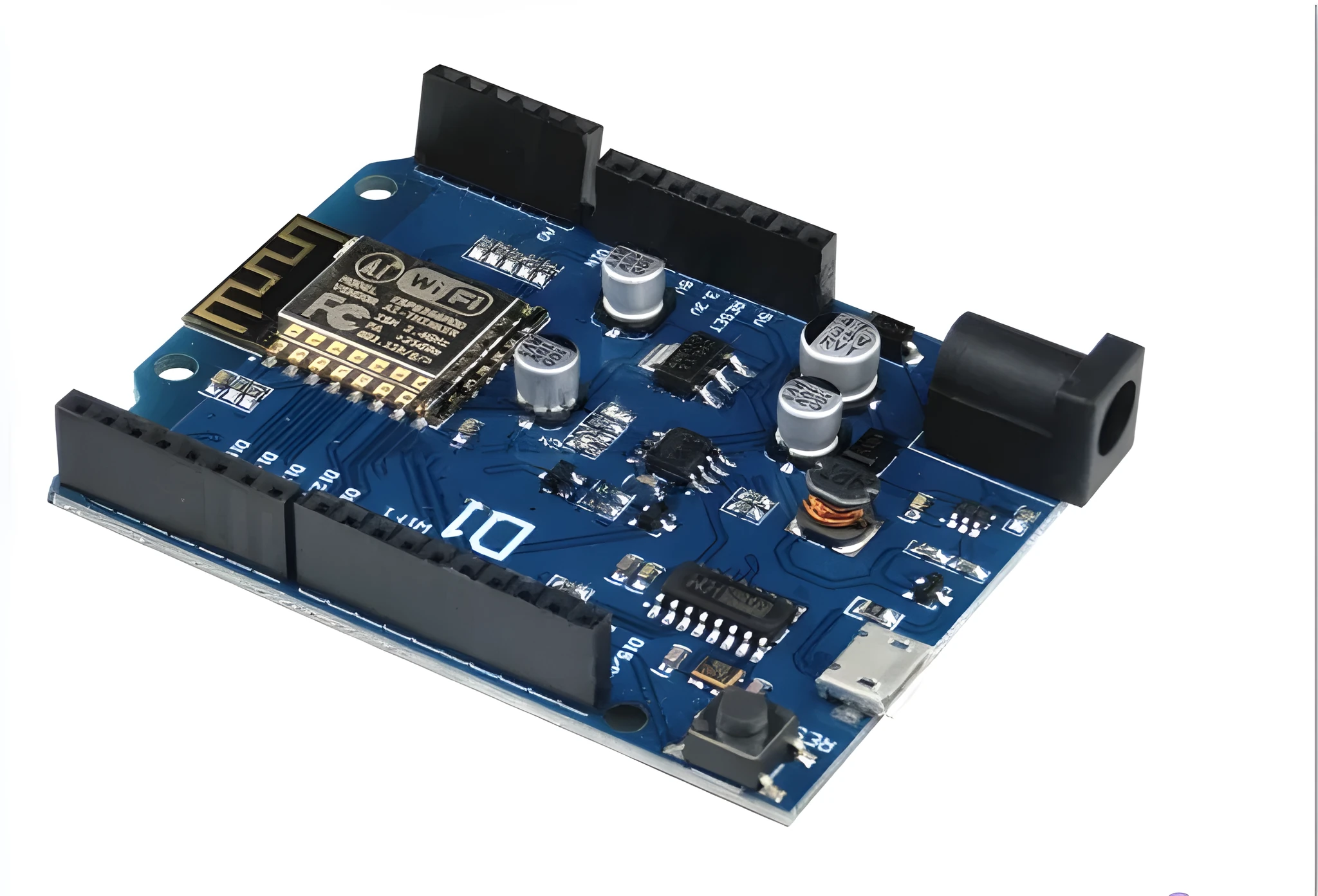
This ESP8266-based development board offers a practical entry point for Internet of Things (IoT) projects requiring wireless connectivity without extensive hardware expertise. Its core functionality revolves around the ESP-8266EX chipset, providing built-in WIFI capabilities in a format familiar to Arduino users. Once the appropriate hardware package is installed, the board operates similarly to an Arduino UNO, allowing developers to leverage existing Arduino IDE knowledge and code libraries. The inclusion of OTA (over-the-air) wireless upload support enables remote firmware updates after deployment, while the integrated 5V 1A switching power supply simplifies project power requirements by accepting input voltages up to 24V.
Features and Construction

The board combines several practical features designed for IoT prototyping and development workflows. Its construction centres on the ESP-8266EX wireless microcontroller, which provides both processing power and WIFI connectivity in a single package. The black printed circuit board hosts the necessary supporting components and pin headers for external connections.
Material and Build
The development board utilises standard electronic manufacturing materials, with a PCB featuring a black solder mask finish. Component selection focuses on providing the specified functionality: the ESP-8266EX chip handles wireless communication and processing, while additional circuitry implements the switching power supply and pin interfaces. Construction follows typical development board standards, with through-hole pin headers for reliable connections to external components and sensors during prototyping.
Size and Practical Fit
While exact physical dimensions are not provided in the source material, the board follows a development board form factor designed for breadboard compatibility and prototyping use. The 11 I/O pins and 1 ADC pin are arranged in a configuration that facilitates connection to sensors, actuators, and other peripheral devices. The onboard power supply's ability to accept input voltages up to 24V and deliver 5V at 1A output helps reduce external power supply requirements for many small-scale IoT applications.
Uses and Placement
This development board suits various wireless IoT applications, from home automation prototypes to sensor network nodes. Its Arduino compatibility makes it particularly accessible for educational settings and hobbyist projects, while the professional features support more advanced deployment scenarios.
Event or Professional Use
For professional prototyping and development, the board provides a cost-effective platform for testing WIFI-connected concepts before moving to custom PCB designs. The OTA wireless upload capability allows for field updates to deployed devices without physical access, useful for remote monitoring systems, environmental sensors, or distributed control applications. The 11 I/O pins and ADC input support connection to various sensors for data collection and actuator control in commercial or industrial proof-of-concept implementations.
Everyday Home Use
Hobbyists and makers can utilise this board for home automation projects such as smart lighting controls, temperature monitoring systems, or security sensors. The Arduino IDE compatibility means extensive community resources, tutorials, and code examples are readily applicable. The onboard power supply simplifies projects by reducing external power components, while the black finish provides a neutral appearance suitable for various project enclosures and installations.
Benefits and Buying Value
The board offers practical advantages for developers at different experience levels, combining accessible programming with capable hardware features. Its value proposition centres on reducing both the learning curve and component count for WIFI-enabled projects.
Reuse and Low Maintenance
The development board supports project iteration through its standard pin headers and breadboard-friendly design, allowing components to be reused across different prototypes. The OTA functionality reduces maintenance requirements for deployed devices by enabling remote updates. The robust power supply design, with its wide input voltage range, helps protect against power-related issues that might otherwise damage connected components during development.
Why Choose This Product
This board presents a practical choice for developers seeking WIFI connectivity with Arduino familiarity. Its specific combination of features – Arduino IDE compatibility, OTA support, onboard power regulation, and sufficient I/O for sensor integration – addresses common requirements for IoT prototyping without requiring multiple separate components. The availability of technical resources via the provided Baidu network disk link offers additional support for implementation and troubleshooting.