

Desktop Dual-Axis Belt Sander with 750W Motor and 40x680mm Abrasive Belt, Professional Sander for Polishing Knife Sharpening Metal Woodworking and Variable Speed 1000-7000 RPM in Blue Finish


Desktop Dual-Axis Belt Sander with 750W Motor and 40x680mm Abrasive Belt, Professional Sander for Polishing Knife Sharpening Metal Woodworking and Variable Speed 1000-7000 RPM in Blue Finish
Desktop Dual-Axis Belt Sander with 750W Motor and Variable Speed Control for Workshop Precision

This professional-grade desktop dual-axis belt sander combines substantial 750W power with precise speed control in a compact 310x250x190mm footprint, making it equally suitable for workshop professionals and serious hobbyists. The continuously variable transmission switch provides exact control over rotation speeds from 1000 to 7000 RPM, allowing users to match performance to specific materials whether sharpening knives, polishing metal surfaces, or finishing woodwork. Its blue-coloured housing offers visual distinction in busy workshop environments while protecting the robust internal components that deliver consistent performance across demanding applications. The dual-axis belt configuration provides flexibility in approach angles, supporting both standard sanding operations and specialised sharpening tasks with the included knife sharpening tool.
Features and Construction
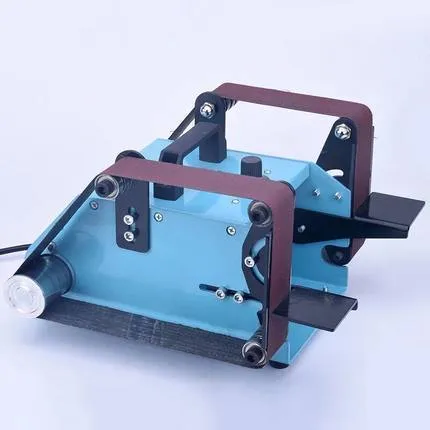
The desktop belt sander's construction centres around practical workshop requirements, balancing power delivery with user control and workspace efficiency. Every element from the motor specifications to the housing dimensions has been configured for reliable performance in professional and home workshop settings where space optimisation matters as much as capability.
Material and Build
The sander's blue-coloured housing provides more than aesthetic appeal—it creates visual contrast against workshop backgrounds for quick identification and houses a 750W motor engineered for sustained operation. This power rating supports continuous use with common materials including wood, metal, and composites without performance drop-off during extended sessions. The housing dimensions of 310x250x190mm represent a deliberate balance between internal component protection and external accessibility, allowing maintenance access while maintaining structural rigidity that minimises vibration transmission during precision work.
Size and Practical Fit
With overall dimensions of 310mm width, 250mm depth, and 190mm height, this desktop sander occupies minimal bench space while providing substantial working capacity through its dual-axis belt configuration. The 40x680mm abrasive belt specification offers sufficient contact area for efficient material removal while remaining within manageable dimensions for controlled handling. This size-to-power ratio makes the unit particularly suitable for workshops where bench real estate is limited but professional results are expected, providing full-size sander capabilities without requiring dedicated floor-standing equipment.
Uses and Placement

The dual-axis belt sander's combination of variable speed control and substantial power output supports diverse applications from precision sharpening to aggressive material removal. Its desktop configuration allows placement flexibility within various workspace types, from professional fabrication shops to home garage workshops where equipment needs to serve multiple purposes within constrained areas.
Event or Professional Use
In professional workshop environments, the 750W motor and 1000-7000 RPM speed range support production-level tasks including tool maintenance, metal part finishing, and component preparation. The continuously variable transmission switch enables fine-tuning for specific materials—lower speeds for delicate finishing work, higher RPMs for efficient stock removal. The included knife sharpening tool expands utility beyond standard sanding operations, creating a multi-function station that reduces equipment changes during complex projects. For fabrication shops with space constraints, the compact footprint allows integration into existing workbenches without requiring dedicated sander stations.
Everyday Home Use
For home workshop users, the desktop design provides professional sanding capabilities without the floor space commitment of larger industrial equipment. The 220V operation makes it compatible with standard workshop power outlets, while the 40x680mm abrasive belt size ensures readily available replacement options from most hardware suppliers. Hobbyists working with wood, metal, or composite materials will appreciate the speed adjustability when transitioning between different project phases—from rough shaping to fine finishing—without changing equipment. The dual-axis configuration offers approach flexibility that single-direction sanders lack, particularly useful for sharpening garden tools, workshop knives, or household implements.
Benefits and Buying Value

This desktop sander delivers value through its combination of professional specifications and space-efficient design, offering capabilities typically found in larger floor-standing units within a benchtop package. The practical benefits extend beyond initial purchase to ongoing operation where power efficiency, maintenance accessibility, and application flexibility contribute to long-term utility.
Reuse and Low Maintenance
The standard 40x680mm abrasive belt specification ensures compatibility with widely available replacement consumables, avoiding proprietary sizing that limits long-term usability. The continuously variable transmission switch reduces wear on both the motor and belts by allowing optimal speed selection for each material type, extending component life compared to single-speed operation. The accessible housing design facilitates routine maintenance when required, though specific maintenance intervals aren't detailed in the source material. This focus on standard components and user-adjustable operation supports sustained performance across years of workshop use.
Why Choose This Product
The desktop dual-axis belt sander stands out for users needing substantial sanding power within confined workspaces, offering 750W motor performance in a 310x250x190mm housing that fits standard workbenches. The variable speed control from 1000 to 7000 RPM provides precision adjustment unavailable on many basic sanders, while the dual-axis configuration increases application versatility beyond single-plane machines. For those sharpening tools or finishing components where exact speed matching improves results, the continuously variable transmission delivers control typically found on more expensive industrial equipment. This combination of professional specifications, compact dimensions, and multi-directional capability creates a practical solution for workshops where space efficiency matters as much as performance capability.
